
live with a hypersomnia

Spotlight — people who have hypersomnias
What’s it like to walk a mile in the shoes of people with hypersomnias? Read their personal stories below.
On June 3, 2017, Board Member Amy Haraden participated in a Patient Panel at the SLEEP2 (PCORI) Conference organized by Project Sleep. SLEEP2 is a project co-led by the University of Arizona, the Sleep Research Network, and Project Sleep and is funded by the Patient-Centered Outcomes Research Institute (PCORI). SLEEP2 aims to engage patients, scientists and other stakeholders as partners across the entire span of sleep research, from topic generation to conduct of studies to disseminating and implementing research findings.
It’s been a long and interesting road. Growing up in the Dakotas, Trevor was an athletic, outgoing, energetic boy. He played soccer and hockey, enjoyed hanging out with his buddies, and was a great student. In retrospect, we noticed a few strange things about his sleep habits. He could fall asleep at a moment’s notice, even in a loud crowd of children’s roughhousing and a noisy television. Many times we had difficulty waking him. Even so, Trevor was a relatively normal, active boy.
At 9, Trevor started showing the beginnings of something not normal. We starting having trouble getting him to hockey practice—something he loved to do. After spending a day in school, he would be so exhausted that he would nap—for hours. If we could get him to practice, when he would return home, he would immediately go to sleep. We wrote this off as growing pains—he had a major growth spurt over a few months’ time.
In middle school, his sleepiness started to be more noticeable. Once, after playing hockey out of town, he asked to go to the car and take a nap while we stayed to watch the other team play. Two hours later, when the other game was done, we went to the car and found Trevor asleep with the doors locked. He had the keys. We couldn’t wake him. Finally, after getting the assistance of three of the coaches, we were able to rock the car enough to awaken him. Something was not right. We talked to our doctor who shrugged it off, even though sleep disorders run in the family.
His sister became very concerned and suggested that Trevor have a sleep study before he started high school. Our doctors refused to do a sleep study prior to Trevor turning 15 years old. In November, when he turned 15, we found a pulmonologist/sleep specialist locally to complete a sleep study. We took Trevor to the sleep lab, where he completed both an overnight study and a daytime Multiple Sleep Latency Test (MSLT). The overnight test showed no abnormalities; however, the MSLT was a different story. Trevor fell asleep almost immediately and was in rapid eye movement (REM) sleep in less than four minutes. Based upon these results, the pulmonologist diagnosed Trevor with severe hypersomnia/narcolepsy without cataplexy. His prescribed treatment included morning and afternoon stimulants (amphetamine and dextroamphetamine—Adderall). We thought, “At last, some relief.”
Trevor joined his regular hockey team about a month after the diagnosis. The stimulants negatively impacted his endurance and breathing. We worked with the pulmonologist to adjust the medications to provide some relief. In January, Trevor’s world came crashing down. He suffered two concussions over a period of one week. He was now also seeing an orthopedic concussion specialist to help him recover. He compared Trevor’s baseline impact test to a current test—Trevor’s results showed significant impairment. Both doctors discussed his recovery path, and they decided that we should take Trevor to a neurologist for treatment.
Nearly a year later, Trevor was cleared from the concussion but was still struggling with his sleep and memory. The neurologist didn’t like Adderall for Trevor’s treatment and prescribed modafinil instead. This was a disaster—Trevor did not respond at all to modafinil. He spent much of the summer in bed, extremely tired and lethargic. Eventually, Trevor requested to switch back to Adderall. At this point, the neurologist became frustrated with Trevor and us. He ordered an MRI—normal; he ordered two separate depression tests—normal. As a family, we felt this doctor was not helping Trevor. We went back to the concussion specialist after an issue Trevor had early in the next hockey season. The concussion doctor ordered neuropsychological testing to measure Trevor’s brain activity and processing capabilities. Through this testing, we discovered some significant deficits in Trevor’s memory and cognitive ability. The concussion specialist suggested that we find another sleep disorder doctor.
After searching the area, making hours of phone calls, gaining approval from the insurance company and asking numerous questions, we found a doctor in Omaha, NE, who thought that he could help. Once we arrived, it became very apparent that this clinic, and this doctor in particular, had no experience with severe cases. Once again, the search continued. We took Trevor to a clinic in the Midwest, where he was accepted for treatment by a nationally known pediatric sleep disorder specialist. The doctor ordered several tests, including a tilt-table test, blood work, and an actigraph. We returned home with an appointment one month later to get the results of the actigraph. Ultimately, the doctor diagnosed Trevor with circadian rhythm disorder in addition to his previous hypersomnia/narcolepsy diagnosis. Trevor was prescribed light-box treatment along with melatonin to assist with his sleep. After this diagnosis, Trevor was sent to a neurologist within this same institution because of the previous concussion to determine if there were any residual effects. This doctor ordered an electroencephalogram (a test that measures brain waves), which came back normal. We asked for a second opinion from another doctor at the same clinic, who prescribed sodium oxybate and removed melatonin from the prescription. Trevor had a bad reaction to sodium oxybate, and we removed it from his treatment. This institution gave up on Trevor, and we gave up on them. Back to square one.
After attempting to work with another local sleep specialist, we were grasping for answers. We contacted Narcolepsy Network, who informed us of two doctors that we should attempt to see. They highly recommended that Trevor get an appointment with Dr. David Rye in Atlanta, GA—they felt that he could help. We contacted Dr. Rye’s office, and they asked that we forward all information and documentation collected during his treatments. Dr. Rye accepted our request and scheduled an appointment with Trevor for a Friday afternoon. We made the 22-hour drive to Atlanta. Dr. Rye evaluated the documentation and then spent a couple of hours visiting with Trevor and our family. He had each of us complete the “reaction box” test. He diagnosed Trevor with idiopathic hypersomnia—IH. At last, some hope.As a family, we have spent countless hours helping Trevor understand his diagnosis. Since the diagnosis, Trevor has graduated from high school. He was able to hold a part-time summer job, working in production with a local sports team. His daily struggles with sleepiness continue, but Trevor is learning his limits and is taking control of his medicine. Although he had to give up playing hockey, he has become one of the best young hockey referees in the state, allowing him to give something back to the sport that he loves. Trevor plans to attend college sometime in the near future—we are working to find a way for him to have a chance to succeed. Even as we are trying to find a way for Trevor to have successful treatment now, he looks forward to advances in treatment for IH—that one day he can return to a more normal existence.
Randy and Nancy Preston – South Dakota
I have always been a person who could not get enough sleep. Regardless of how long I slept—13 or 14 hours a night was commonplace—I still never felt refreshed upon waking.
My teenage years were tough. My school attendance record was appalling, but I could never bring myself to give “tiredness” as a reason, so I used to invent headaches, stomach pains, sickness, etc., as a way to skip school. I guess I was worried that saying I was too tired to go to school would be laughed at.
Thankfully I was a “naturally bright child,” so I left school with very good grades. This enabled me to follow my ambition of working in the financial markets in the city of London. I soon found that working for a living and being constantly tired didn’t mix well. I struggled. Big time. For years, my life literally consisted of getting up (which was a challenge in itself), going to work, coming home, and going straight to bed. Somehow I managed to progress through the ranks, and, in my early 20s, I became a trader. It was a high-pressure job, but I knew that my increasing fatigue wasn’t being caused by my occupation. I often slept in the restroom during my lunch break, and it got to the point where, with my boss’s permission, I would curl up under my desk for a nap several times a day. Even though my boss was understanding, she insisted I seek medical help. And that is where the real struggles began.
Although a fantastic concept, the UK’s free National Health Service isn’t ideal when it comes to ailments that don’t fit neatly into a particular box. Within the space of a year, I probably saw my general practitioner 10 or 11 times. Each time, I was made to feel like I was wasting his time, and I would leave his office with a different suggestion: no caffeine after 4 pm, no exercise (I wish that would have been possible!) after 5 pm, a little exercise before bed, a hot bedroom, a cold bedroom, lavender oil on my pillow, blackout blinds, a change of diet, vitamins, relaxation tapes, yoga, turn my bed so it faced a southerly direction. The list was endless.
On one such visit, in desperation, I physically refused to leave, saying that either my doctor had to refer me to a specialist (although, at the time, I had absolutely no idea what kind of specialist I would need to see) or he would need to call the police to have me removed. Thankfully, he gave me a referral to a narcolepsy clinic.
Although I knew I didn’t have narcolepsy, I was relieved that I had now been placed into the “system.” Having waited over 6 months for this consultation (another downside to free healthcare is the waiting times), I was told less than a minute into the appointment that I didn’t have narcolepsy and that there was nothing the doctor could do to help me. I cried. And I believe it was only because of my visible distress that he said he would do me a “favor” and ask a friend of his (who was a specialist in sleep and respiratory conditions) to see me.
By the time I had my first sleep study, I was 27 years old. After the study, I was told that I had idiopathic hypersomnia. I cried again, this time out of relief that there was actually something “officially” wrong with me and that it wasn’t “normal” to be feeling like I had for so many years. I was prescribed modafinil, and, for the first time in my life, I experienced what it was like to be “normal.” I used to think it was amazing to be able to go to work, be productive, and then be able to go out in the evening, too. But, of course, for everyone else, this was just life.
About a year later, the continual tiredness began to creep slowly back in. I had become tolerant to that drug. I was then put on methylphenidate. Once again, I experienced what it was like to be alive. After a few years (with regular increases of dosage), this drug also started to be less effective. I was then prescribed dexamphetamine. It became clear that, despite being on the maximum dose, this drug didn’t work as well as the methylphenidate I had recently been prescribed. So, I returned to that. I was acutely aware that I was now on the “best of a bad bunch” and that l was unlikely to return to a normal active life for some time, if ever.
The methylphenidate slowly became less and less effective. I was put back on modafinil but suffered horrendous side effects. I moved back to, and I’m currently on, dexamphetamine. This also has little effect but is better than nothing.
I long to return to the life, a life I experienced in my late 20s whilst on modafinil for the first time. I am now 37, and, during my adulthood, I can honestly say I have only “lived” for two, maybe three, of those years. My specialist has said I have exhausted all drugs currently allowed for IH in the UK. I have mentioned flumazenil and clarithromycin but was told these weren’t currently an option.
Life is short enough as it, and thus far I feel I’ve been robbed of most of it. I truly hope further research, better medications, or, ideally, a cure is found for this awful illness soon.
B.H.- UK
One would think that my mother chose one of those underwater birthing experiences or a birth assisted by dolphins when she had me…since I’ve spent my entire life in or under water.
Literally? No, figuratively—living in and under water is my analogy for how it feels to live with hypersomnia. While most of the world sleep in shallow water at night and pop up onto the dry land where they stride about all day, I sleep in the depths and only make it to more shallow water during the day, still over my head though. I feel as though the vast majority of people live on land and only sleep in the water; whereas I live in the water and seldom make it to land. In other words, most people’s natural state is wakefulness with periods of sleep, and my natural state is asleep with periods of wakefulness.
I am not exaggerating when I say this: that I can probably only remember two days of my life spent on dry land. And waking up feeling rested?—Fewer than a handful of times. Even Ritalin (methylphenidate) or Provigil (modafinil) just helps keep me in shallower waters: if I’m having a more alert day and the medication is working well, it allows me to wade around in thigh-deep water and relieves me from having to swim or tread. If I’m having a more sleepy day or the medication is not working well, it only helps me to tread or swim a little faster.
So, here’s me at work next to a “normal” person—she is sitting or standing on dry land working away and I’m next to her swimming to keep up and treading to keep my head above water (in other words, to stay awake and cut through the brain fog) while attempting to do the same job. It’s a constant struggle. No wonder I’m slower and distracted.
In addition to having idiopathic hypersomnia (IH), my circadian rhythm is set much later than other peoples’. In the depths of the ocean where I sleep, the sun only penetrates to those depths at around 10 am or later. Even waking up then is a struggle, and I set three alarm clocks. I sleep in the deep end OF THE OCEAN, and it takes a long time and a lot of work to swim to the surface and then close to the shore every day. My alarm clocks (when I hear them and don’t turn them off in my sleep) are like the crash of the waves on the shore to let me know in which direction to swim. If they keep splashing and crashing and I keep swimming, I can usually make it to the surface in 30 to 60 minutes.
While I am attempting to wake up, here is one problem: In the nanosecond between the thought “I need to get out of bed” and carrying out that action of getting out of bed, I fall back to sleep. It is difficult to sustain an awake state long enough to act on the intention of arising. This is when I especially feel that I am drowning in sleep—I just keep slipping back under the surface.
Even in my daytime, the water level is deep. When I sit in a chair, couch, or car, I’m under water (asleep) in 20 to 30 minutes. Even when I am standing up, I am still in water over my head, meaning that I’m constantly treading water or else I’ll slip under. To get through college, I had to jog in place while standing at a lectern (that held my books and notes) because I kept falling asleep standing up while studying. Unfortunately, my car requires that the driver be seated while driving, so it’s short trips for me, or I have to take Ritalin to drive more than half an hour.
Stimulants and medications, however, do not mean smooth sailing for me—I can barely tolerate them, and certainly not every day. All of them make my Reynaud symptoms worse, dry my eyes, and give me very unpleasant side effects. If I were to drink even half a cup of coffee, my heart would race, my hair stand on end, and my mind race; the words on the computer screen would float away; I would sweat and have heart palpitations; my dry eyes would dry out even more. Needless to say, I don’t ever use any caffeine. When I take Ritalin, I get the same side effects plus I shiver all day long. People are constantly offering to get me a coat, sweater or blanket. (Same thing happened to my daughter when her doctor tried her on it for her ADHD.) On the rare occasions that I take modafinil, such as when I have to drive for several hours, (something I avoid as much as possible), I will not only have the side effects, but I know I’m in for a night of being tossed in the surf. It’s not that I can’t sleep, it’s just that I fall asleep and wake up every few minutes all night long and am most miserable the next day. The waves toss me ashore, then pull me back out to sea; toss me ashore, then back out to sea, and on it goes all night long. The same thing happens if I take a second, afternoon, dose of Ritalin or take Ritalin two days in a row.
The tides in my ocean are quite unique. Instead of cycling through two high and low tides twice a day as our planet’s oceans do, my high tide rolls in around midnight, pulls me out to the deep (sleep), and doesn’t begin to ebb for 12 to 14 hours. If I start my day earlier and swim to the surface near the shore before ebb tide, the water is deeper and rougher and stays that way all day—no low tide for me!
Often, for no reason that I can discern, a riptide or undertow will roll in in the late afternoon or at seven in the evening for an hour or two. At times I am able to keep my head above water, and at other times it sucks me out to sea. The late afternoon undertows are erratic, but the 7 pm riptides will run for weeks at a time.
Many insomniacs who have said to me, “I wish I could sleep like you do!” To them I say wryly, “Come on in, the water’s fine!” (If they only knew!)
Lisa R
Until the summer after I graduated from high school, I had seemingly unlimited energy. A typical day for me would be waking at 5:00 am, attending class until 1:30, and then cramming in homework before heading to marching band or track practice. Often I’d arrive home after dark, allowing just enough time to eat dinner and then continuing to study late into the night. Sleep wasn’t on my priority list. I never gave a thought to the fact that I might be abusing my body on so little sleep.
All that changed when I got sick with mononucleosis and tonsillitis a few months before I started college —in hindsight, a turning point in my life. In the fall, I started napping between college classes and drinking caffeine both day and night to stay awake while studying. I was also getting sick more frequently. Every few months, I’d come down with another virus. Strep and tonsillitis seemed to be a regular occurrence in my life. I managed to push through though and successfully graduated in 2002 with my BS in wellness leadership. What’s funny for me in looking back is that, even though my major was wellness, my professors spent little if any time discussing sleep health.
After graduation I worked a number of soul-sucking jobs because I’d been told I’d never make any decent money working in wellness. Each of these jobs paid well, but doing work that wasn’t authentically me left me feeling stressed out and miserable. By 2007 I’d had enough and knew that if I didn’t make a change, something bad was going to happen. I certified as a personal trainer and began working for a local gym. The new environment and focusing each day on my passion of helping others get healthy definitely improved my mental health, but my daily fatigue continued to worsen. I’d drive home and nap between clients, leaving little time for me to exercise. I felt like a hypocrite. Here I was, a personal trainer lecturing my clients on making time to exercise a priority in their lives, and yet I wasn’t able to model those behaviors myself.
Depressed, I began seeing a psychiatrist. Was something wrong with me? Was I just not motivated enough? Like many others with a sleep disorder often do, initially I was diagnosed with depression and prescribed an antidepressant. The medicine seemed to help for a while. I actually felt a little more energetic, but, over time, the fatigue took over again. A visit to my primary care doctor revealed normal lab test results, so she referred me to a sleep specialist. I completed a sleep study, was told I had sleep apnea, and was sent home with my first CPAP machine. Being only 28 years old at the time and newly married, being prescribed a CPAP felt like being given a life sentence. Three months later, I gladly traded that machine for an oral appliance, which definitely made a difference. I wasn’t running around like the energizer bunny, but I didn’t feel like I needed to stay in bed all day either. I slowly came to terms with having sleep apnea, even though I didn’t fit the typical profile of an overweight middle-aged man. I tried to go about living my life as usual and thought my sleep issue was FIXED.
The following year, my husband and I welcomed our son into the family—I was tired during my pregnancy, but nothing serious. In the instant that Blake was born, however, my whole world changed forever. I could no longer compensate for feeling tired by napping during the day, sleeping in on weekends, and getting to bed early. Those first few months were so hard. I was exhausted and depressed and wondered if maybe I wasn’t cut out for this “being a mom” thing. I also didn’t know at the time that the extreme sleep deprivation I was experiencing wasn’t your typical “new mommy” kind of tiredness.
Six months later, I visited my sleep physician and explained that, in addition to being so sleepy during the day, I’d been having vivid recurrent dreams during my naps of a burglar breaking into the house. I was terrified the burglar was going to take Blake. As I would see the shadow of a man standing over me, I would try to scream or move, but my body wouldn’t respond. After hearing about what I’d been going through, my sleep physician ordered another sleep study and an MSLT, which showed that I had narcolepsy—what a relief! For years, I had felt a little bit crazy; I couldn’t stop beating myself up about being lazy or unmotivated. I could finally breathe knowing that a real reason explained all the things I’d been battling for years.
Living with two sleep disorders has been really challenging for me and for my family. I’ve worked with several different sleep specialists and tried out a variety of different medications. However, usually any positive effects of medications only last for a while, and they often come with many side effects. Coming to terms with the fact that I’ll have to live with these disorders the rest of my life has been a slow process. Thankfully I have a huge support system that includes my family, friends, and coworkers. Because of their support I’ve been lucky enough to be able to juggle a career I love–working as a Fitness & Wellness Specialist–with being a wife and mom to my wonderful husband and children.
I also found that connecting with others living with sleep disorders could sometimes be just as helpful as taking a medication. Shortly after being diagnosed with narcolepsy, I discovered a blog called REM Runner written by July Flygare, the founder of Project Sleep, a nonprofit that raises awareness for sleep health and sleep disorders. Through Julie’s blog, I discovered the “NARCOLEPSY: NOT ALONE” campaign. Julie created this international campaign to raise awareness about narcolepsy and to prove that narcolepsy is real and that those living with the disorder are NOT ALONE. I participated in the campaign and then felt inspired to get involved with advocacy myself. I’m on a personal mission to spread the word and possibly help someone else out there that might be feeling the same way I once did. I believe that now is the time to help the world understand that sleepiness is NOT laziness, that napping is NOT a luxury, and that sleep disorders are REAL!
It’s the end of the day and the awake drugs I take so that I can function during the day have worn off. I’m super sleepy now, but my husband, who is cooking me dinner, asks me to go to Kroger to buy three items we need. I can handle three items and I know where they are in Kroger. The store is only three or four miles from the house. I can do this thing Chris asks of me.
I get to Kroger and find my three items; I pay and leave.
While I am in the parking lot walking to the car, I get a text from Chris. He is requesting that I also pick up some garlic powder. I put my three items in the car and go back in to Kroger for the garlic powder.
Seasonings…where does Kroger put the seasonings? I walk along the front of the store reading the boards near the ceiling. They don’t list “seasoning.” Hmmm…seasoning, where does Kroger put that? It’s garlic; maybe it’s near the produce section? I walk over to produce and it’s not there.
Seasonings…I walk up and down the aisles looking for seasonings.
I can’t find it.
How do people find seasoning when they’re in a grocery store? Where would Kroger put it?
I walk along the back of the store reading the boards. No “seasoning” listed at the back of the store either. I missed it in produce, let me go back there and recheck…Garlic…Maybe it’s with the salt? It’s a salt after all…Oh, look in produce first, that’s where I was headed. No, it’s definitely not in produce. Now, where was I going to try next? Oh, salt. Garlic salt. Yes, I’ll go look there.
Here is the salt, no garlic salt! Grrr! Why doesn’t Kroger just carry garlic salt next to the garlic or the salt? How difficult would that be? Hmm…That’s not right, I’m not looking for garlic salt. I’ll have to call Chris and ask him what I need to get. I pull out my phone and see the text from him. POWDER! Oh! And I’ve been looking for SALT! Geeze, concentrate! Now, seasonings…I can’t find it. Forget it.
I know where it is in the other grocery store, and that one is on my way home. I’ll just go there. It’ll be easier.
I go to the other store and walk right to garlic powder and make my purchase.
I get home and walk in and triumphantly hand Chris the garlic powder. Mission accomplished!
Oh, there were three other items. They’re still in the car. I’ll go get them.
I hand Chris the bag with the three items, and he notices something is very wrong with me. He asks me about it and I ask him, “Who can’t find the seasonings in Kroger?” He looks at me, surprised.
“Seasonings?”
“You were looking for seasoning?”
“Yes, that’s what you requested that I couldn’t find.”
“Did you think about looking for ‘spice’?”
“Oh. No.”
“Did you ask someone at Kroger where they keep the garlic powder?”
“No. I didn’t think of that.”
“It’s o.k. honey, you can go to sleep now, and tomorrow it will be better.”
Or not.
Sara, 36
guess my story is a lot like other people’s stories. . .or at least I hope it’s a lot like theirs.
My symptoms started when I was about 14 years old. Actually, except for my early childhood, I don’t really remember being awake a lot. In school, I basically slept every day, and some of my teachers started to worry about me, but I was one of the best students in school, so, after a while, my teachers just accepted my sleepiness.
All teenagers sleep a lot, so my mom wasn’t too worried. I went to see many doctors over the years. They checked me, but it was nothing serious, so they told me not to worry. My father died when I was 15, so a lot of doctors thought that I was just depressed. Once I told them about my loss, they would stop taking my sleep issues seriously and try to send me to therapy. So, I just stopped telling them about my sleepiness because I always knew it was something else. It wasn’t that I didn’t want to get up or stay awake. I didn’t want to stay in bed all day. I just could not do it.
One of my first memories about having issues with IH happened when I was 16. I was on a weekend trip to Rome with my boyfriend. I couldn’t accept that I needed to sleep all the time. . . that I couldn’t get up before 11 and that we had to go back to the hostel every few hours to take naps. We fought a lot, and I realized that I needed to do something.
I went to see a neurologist. I owe that man a lot. He was the first one to take me seriously. He never told me that it was normal for a teenager to sleep a lot, like the other doctors had. He knew that there was something wrong with me and arranged an appointment for me with Prof. Dr. Mayer at the Hephata Clinic in Schwalmstadt-Treysa, Germany. Prof. Dr. Mayer is one of the best doctors I’ve ever met. I spent a week in his clinic and did countless tests. At the end, I was diagnosed with IH. And, like most of people with IH, I finally felt free. My problem had a name. There is no cure, but just knowing that it wasn’t in my head, helped me a lot. He encouraged me to share my feelings and struggles with my friends and family. He was the first one to give me modafinil. I reacted (and still do react) very well to modafinil. I found a way to take as little as possible, but as much as I need. But I’m still struggling with my disorder every day.
I think the biggest problem for people with IH is the lack of acceptance in our society. In high school, my friends laughed about me when I was sleeping. They took photos of me sleeping in class, in a club, or even in the Sistine chapel in Rome. I never had a problem with that. It was their way of accepting me, as they never expected me to be awake, or pressured me in any way. If I told them I was tired, they accepted it and helped me.
After graduation from high school, I traveled in Asia and America for six months. It was a great time, primarily because I was traveling on my own and on my own schedule. I was able to sleep. Nobody told me to get up if I was sleeping for 18 hours straight. And I didn’t have to get up because there was nothing for me to do besides relax and travel.
In 2013, I moved to another city to begin attending university. The first problem was finding a doctor who understood my disorder. I went to a lot of doctors, but they all had to Google my symptoms and told me I was very “interesting.” I still see a doctor, but I have to tell her my doses for my drugs and which tests she needs to do. I started looking for support groups, online chats, anything. I couldn’t find anything in Germany that helped me.
My roommates started to be suspicious. They told me it was “weird” that sometimes I can and sometimes I can’t get up. They complained about my really loud alarm clock. I told them that even with the alarm clock, I can’t get up sometimes. People started telling me I was lazy because I couldn’t go to class on bad days. They told me I was never going to be able to finish school. Because I continue to have good grades, I am not too worried about that part, but I know that I’m never going to be able to work 8 hours a day.
My friends here think I’m lazy. Every time I try to tell them how much it hurts, they tell me that they’re sorry. But it’s not changing. I have the same problem with my mom. She really tries to accept my disorder, but it’s hard for her. She sometimes get’s really angry at me, if I can’t get up. Before I was diagnosed, I thought I was a lazy person. But I’m not. None of us is. But a lot of people don’t get that. I am not lazy. I just can’t help myself. It’s hard to explain to people how you feel with IH. Everybody thinks, “Well, I’m also very sleepy a lot. Get over it. I know what it feels like.” You don’t know what it feels like to always be sleepy—to wish, that you could be awake, just for a week, or a day—because you can’t remember what it’s like to be awake.
People look at you, and judge you. And if you try to explain yourself, they don’t listen. For me, that’s my daily struggle—not the sleepiness, but dealing with other people. And even the people who want to understand, don’t really understand. Like my mother—sometimes I wish I were better at explaining myself. But how do you tell a healthy person how IH feels? I think this is a question everyone with IH asks themselves at one point.
Sometimes I’m sad and I don’t feel as if anyone is listening. I turn on my computer and go to a website like this one. And I know that I’m not alone. And that it’s not just in my head. And I read other people’s stories and I feel better. Because I know that we understand each other.
None of us is alone. And I’m never going to give up. I’m always going to try to make people understand and to accept our disorder. That’s the most important thing for me.
Katharina | 22 | Leipzig, Germany
In this personal story published on HuffPost, a woman with postural orthostatic tachycardia syndrome (POTS) shares why she’s done hiding her invisible disability. It can be a struggle to be vocal about your daily needs; hopefully this article will encourage you to find your voice.
Stories from people
Living with IH
Meghan Mallare
“Sleeping My Life Away”
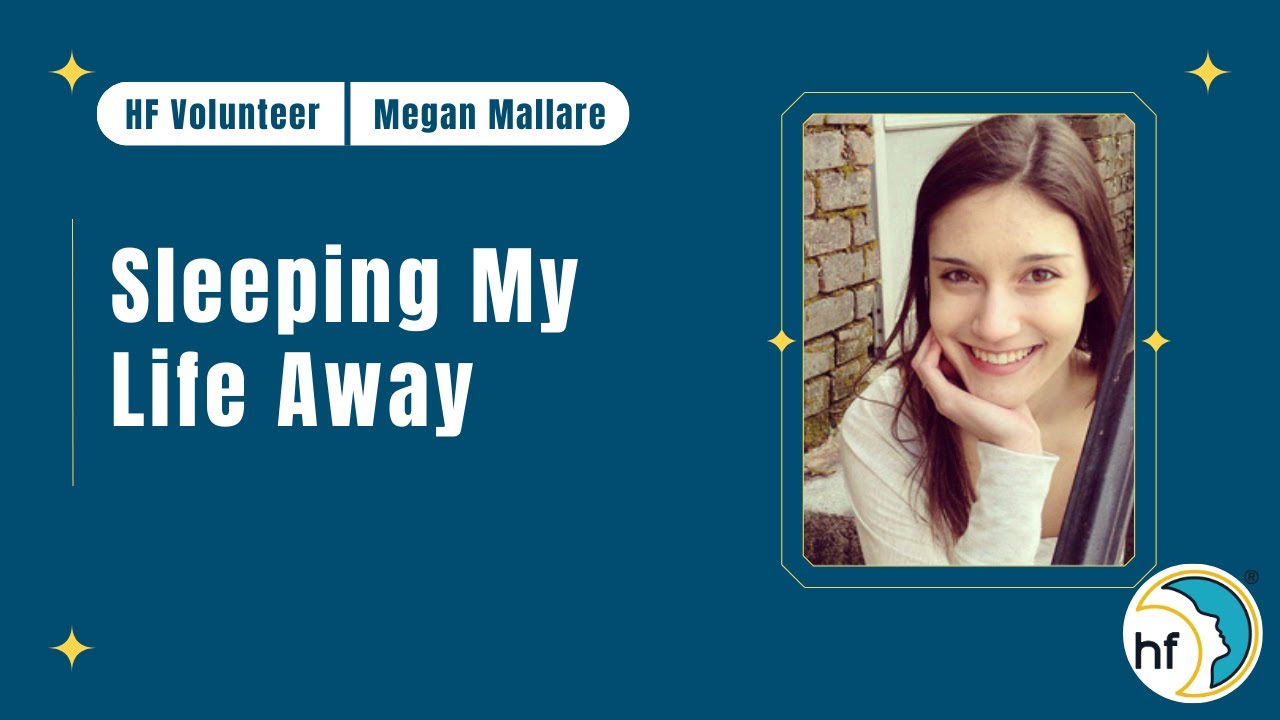
Meghan has IH with long sleep time. For Meghan, the hardest thing is waking up every day.
Meghan Mallare – “Sleeping My Life Away”
Meghan Mallare is 26 years old and from southwest Virginia. When she is not sleeping her life away, she works part time as a medical scribe and enjoys cooking and spending time with her puppy. In this video, Meghan describes the profound impact idiopathic hypersomnia has had on her life. She shares the long journey to diagnosis and the misconceptions surrounding this condition. She also describes the emotional, physical, social, and professional difficulties of being a young adult living with IH.
-
More Details
Michelle Emrich, MD
“A Doctor’s Once Agile Brain Broken by IH”

Michelle has IH without long sleep time overlapping with narcolepsy type 2. For Michelle, the hardest thing is struggling with severe brain fog during the day.
Michelle Emrich, MD – “A Doctor’s Once Agile Brain Broken by IH”
Michelle Emrich is an internal medicine physician whose beloved career was cut short when she was 32 years old by the onset of severe, treatment-refractory idiopathic hypersomnia. In this video, she describes how IH broke her formerly agile brain, leading to unrelenting and painfully intense sleepiness, severe brain fog with associated cognitive dysfunction, and the need for multiple daily obligatory daytime sleep sessions. Michelle describes the huge impact of IH on every aspect of her life and the great importance of therapy and supportive healthcare providers. She hopes that sharing her story will help foster better understanding of this invisible disease.
-
More Details
Christina Brundage
“Volunteering for IH Clinical Trials”

Christina Brundage, Hypersomnia Foundation Volunteer and IH Patient Advocate shares her personal experiences
Christina Brundage – “Christina’s Story: Volunteering for IH Clinical Trials”
Christina Brundage, Hypersomnia Foundation Volunteer and IH Patient Advocate shares her personal experiences in “Christina’s Story: Volunteering for IH Clinical Trials”. This video is an excerpt from The Research Continues – HF’s Virtual Hypersomnia Educational Event
-
More Details
Amy Haraden
Living With IH at SLEEP2 Conference

Share your journey
Coming to terms with having a chronic condition such as idiopathic hypersomnia, Kleine-Levin syndrome, or narcolepsy type 1 or 2 often involves a long and difficult process. Unfortunately, the journey doesn’t end once you reach the correct diagnosis. Knowing that others have taken a similar journey can help lower your burden. And hearing about others’ coping strategies can help people who are currently struggling.
Maybe you found the words that helped a doctor understand you. Perhaps you made specific strategies over the years that helped you to function better. Possibly you identified a new career that helped you to maximize your potential. Consider helping others by sharing your story with us.