Education Guidebook B:
Experiential Learning
This guidebook provides general information about experiential education and what it means to learn from experience (i.e., learn experientially). The discussion focuses on what is useful to know about this approach to learning, examples of experiential activities and those with the potential for “high impact” learning, and the types of instruction used in experiential education. Students who have idiopathic hypersomnia (IH) are provided information that will allow them to make more informed decisions about whether experiential learning is a good fit with their IH symptoms.
This guidebook is one of three included with the #4 Guide to Academic Resources for College Students Who Have IH. These guidebooks introduce students to different ways of learning based on how courses are taught: instructed learning, experiential learning; and online learning. Students who have IH can use these resources to determine “good fits” between their options for learning and IH symptoms.
- Education Guidebook A: Instructed Learning is discussed in terms of methods of instruction; potential issues for students who have IH are identified.
- Education Guidebook B: Experiential Learning* and its varied practices are described, and potential concerns for students who have IH are noted. *learning by discovering knowledge when actively working on a project, problem, or issue and critically reflecting about it.
- Education Guidebook C: Online Learning is discussed in terms of five (5) critical considerations, and issues are flagged where caution is advised.
There are four (4) built-in resources in this guidebook:
Student TIPS!
Student tips flag potential issues for IH symptoms (e.g., attendance, attentiveness, engagement, etc.) and also provide information related to the topic being discussed.
GLOSSARY of Experiential Practices
This provides the structure for the latter half of this section of the Guide. Entries in the GLOSSARY are alphabetized and their references are noted in the GLOSSARY KEY at the end of the Guidebook.
A PEEK Behind the Instructor’s Door
These provide information that may be useful to both students and instructors. Being informed about what goes on “behind the scenes” may help students who have IH make sense of what they experience in the course.
The VOICES of IH
These provide commentary by college students of all ages about their experiences with experiential learning.
A Journey in Discovery
When choosing courses, students who have IH seek good fits with their sleeping and eating schedules, academic requirements, personal interests, and IH symptoms. When a choice is possible, students also want a good fit with how courses are instructed. For example, a lecture-based course may appeal to some students who have IH, but not all. Many who struggle with 1) sitting in lecture halls, 2) listening to recorded classes later that day, or 3) reviewing class notes with peers, may prefer courses where they learn by becoming involved in activities.
The term that describes this way of instructing and learning is “experiential” and is often described as learning by doing or learning through discovery. In other words, learning happens when involved in an activity and thinking critically about that activity and the learning that is taking place (Dewey, 1933,1938; Duley, 2014).
This method of instruction actively involves the student in learning through discovery of knowledge by working on a project, problem, or issue and critically reflecting about it. This can be the primary way of learning for the course (e.g., internship), the basis of class-related activities and assignments, or a component of academic programs. Examples include working on problems or projects for classes, service-learning, and course or program-related practicum experiences. For a better understanding about learning experientially, see the section that follows titled Learning by Doing.
How the term experiential education is described depends on which group of experts is asked (AEE; Eyler, 2009; SEE; NSEE). Regardless of , these differences, students can expect the following characteristics in a course that is taught experientially:
- Students have access to many types of learning experiences, on and off campus, which provide opportunities for immersive, hands-on learning, achieved though involvement in activities, projects, problems, and issues in keeping with the identified learning goals of the course.
- Students are actively engaged in learning activities under the supervision of the instructor.
- Students use reflective techniques to think critically about their experiences and process what they are learning (knowledge, skills, values, and perceptions).
Student TIPS!
Students are reminded that experiential learning may or may not be a good fit with their IH symptoms. Students who have IH should look at the Student Tips entries in this section of the Guide before making decisions. If there are concerns, students may want to talk with their accessibility specialists and/or the course instructors about the expectations of the course, so the students can judge how much of a good fit it is. If it is not a good fit, the student may want to discuss their challenges with the accessibility specialist and then the instructor to identify ways to meet the course requirements. It is very important that those discussions take place during the academic term before students plan to enroll in the course, so that the students are adequately prepared for the course registration period. There also is very useful information in the Education Essentials Guide #5 Advice to and From College in these sections of that guide:
- Choose Courses You Can Manage (#1 Advice From Administrators)
- Find the Path That Best Fits Your Needs (#5 Advice From Faculty)
- The Right Fit Gets the Last Word (#7 Advice From Career Services)
Learning by Doing
The experiential approach to learning differs considerably from the traditional classroom approach (Coleman, 1977). Consider the differences between the ways in which roommates Z and J are expected to learn the same subject matter in separate courses that have the same course descriptions and learning goals but are taught quite differently.
Z is enrolled in a course of 50 students where the instructor places the student front and center for learning happen. Z is involved in a project for the course that is based on an actual problem or issue where Z can discover knowledge with minimal involvement by the instructor. Z may work alone or with a team of peers. Z is actively involved in and makes decisions throughout the project; the effects of Z’s actions and decisions on the project become apparent, as do how the principles and theories Z is studying apply to it. Z often has choices about assignments (choice of readings, focus of papers) and processes what is being learned (knowledge, skills, values, perspectives) through critical reflection techniques such as structured journal entries, scenario discussions, small group problem solving, etc. Instead of being tested, Z is assessed on how well Z demonstrates knowledge of the subject matter through papers and demonstration of competencies and skills while working on the project.
J. by contrast, is in a class of 50 students where the instructor is front and center in the learning — “the sage on the stage” — imparting information and wisdom to J. who passively listens and takes notes while trying to process what is being said. Throughout the course, the instructor determines what information J needs to know and how J should interpret it; the instructor chooses the textbooks and the assignments. J memorizes the notes from classes and is tested on what J can recall. J writes papers on topics determined by the instructor.
Why is the contrast between the ways Z and J learn important? Aren’t both students learning? The traditional method of instruction and learning is often about information transfer to the student. Students are expected to infer the application of theories and general principles, rather than discover them by working on real-life problems and issues (Coleman, 1977). When “knowledge” is delivered to students in such traditional ways and is not discovered by the students using higher-level cognitive skills, an awareness of themselves as learners, and a true understanding of the material may not occur. What results is referred to as surface, rather than deep learning (Suskie, L. 2009; Weimer, 2012). In time, students do not remember what they “learned” because information transfer is not about learning. Simply put, the method is not effective for learning course material (Mazur, 2013, 2014, 2016).
Experiential Learning in Academic Courses
When students enroll in a course with experiential components, they could be involved in a service-learning project, an undergraduate research study, an internship, a class project such as Z’s, or other activities. Course instructors oversee and guide students as they explore, probe, and question aspects of their work—with the goal of discovering new knowledge and perspectives and developing new skills. That is how students make meaning of their work, i.e. how they understand and make sense of what they do, the context in which they do it (the organization, its community [local and global], the cultures, professional associates, etc.), and what they are learning about themselves (Eyler, 2009; Mizerow, 1991; Zittoun T. & Brinkmann S., 2012).
Figure 1
Degrees of Experiential Integration in a Course
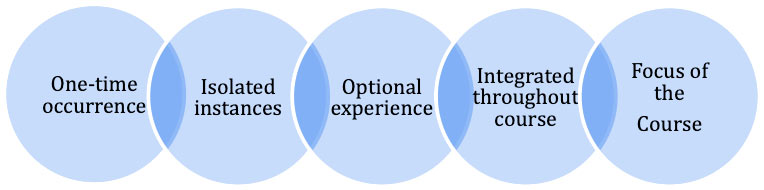
The visual above conveys how components of an academic course can be dedicated to learning experientially. In those components, students process their experiences through structured activities such as focused journal exercises, critical learning logs, vignettes for discussion, etc.; the learning is assessed based on the students’ demonstration of competencies, quality of assignments, and the attainment of the identified learning goals for the experience (Eyler & Giles, 1999; Stanton, 1996). In practical terms,
- A full-time internship is an example of when the experience is the focus of the entire course
- A service-learning project is an example of an experience that is or may be integrated throughout the course; the time on-campus (or online) might consist of weekly discussion meetings focusing on readings related to the issues and problems students are tackling in the service-learning projects
- A course-related practicum, in which the student assists a few hours each week at the local food pantry instead of reading and writing a paper on one of the optional course readings, is an example of an optional experience of experiential learning in a course
- An isolated instance can be assisting an ESL teacher at the local high school when the aide is not available
- A one-time occurrence can be spending a day during an academic term helping with a project identified by community leaders
Student TIPS!
It is important to note that the experiential components of a course are learning experiences with very specific learning outcomes (goals), not volunteer experiences. There are important differences between these experiences, even if at first glance it may be difficult to tell the difference between the student involved in experiential learning and a student volunteer.
The requirements, expectations, degree of student involvement, and assessment of learning for learning experiences differ significantly from what is expected of a student volunteer at the same site. Instructors oversee learning experiences associated with the courses; when those experiences occur off-campus or in a department or program on campus, the student has an onsite supervisor with recognized expertise. The grades earned for these experiences are based on how well the student demonstrates what has been learned (knowledge, perspectives, skills, values), the expected competencies developed through the work, and the papers submitted about the experience. As you can see, this is NOT volunteer work!
Students who are learning remotely are also able to access experiential learning practices through their online courses. Examples include virtual internships and a virtual course practicum. Academic advisors and accessibility specialists can provide information about those courses which have experiential components. More information about studying remotely can be found in Education Guidebook C: Online Learning.
Experiential practices, such as those identified in the mandala below, may be part of academic coursework and campus-life programs. The ones identified below are the more common ones. They are listed alphabetically (clockwise) and described in the GLOSSARY of Experiential Practices & Terms at the end of this guide.
Figure 2
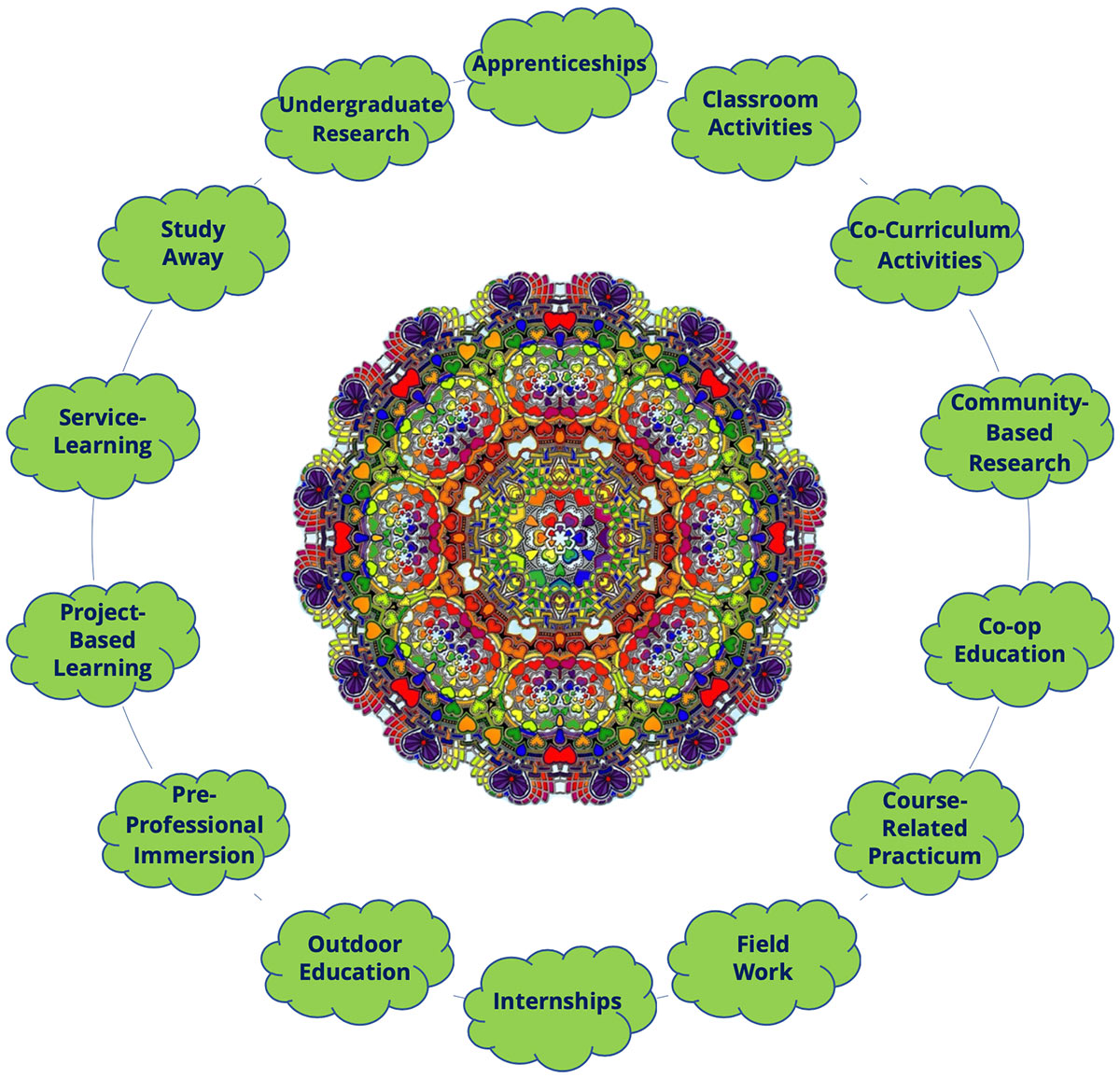
The Mandala of Experiential Learning Practices
Note. Giles & King, 2014; 2020
Because of the non-traditional nature of experiential learning practices, academic programs and campus administrators closely monitor those practices on and off campus. Academic programs that incorporate this approach into courses or program requirements must demonstrate that the quality of learning and the instructional methods meet (1) best practices in the field of experiential education and (2) the credentialing standards for the campus and its academic programs (chea.org; King, 2013).
Student TIPS!
Advice About Off-Campus Experiences
Although the experiential learning practices included in the Mandala can take place on campus as well as off-campus, sometimes in a different locale, state, or country. These tips are from alums who have IH.
- An off-campus location can pose significant challenges for a student who has IH, including but not limited to available modes of transportation and travel time. Students may be required to get up earlier to budget for travel time, especially if they need to rely on public transportation, because driving early in the morning or after an arduous day in the field may be too demanding for students who have IH (whether their experience is student teaching, human service work, or time at a geological site).
- Attending college in Canada? Check out CEWIL for financial support for your off campus experiences. Funding is available from the Federal Government of Canada to provide financial support to students required to participate in traditionally unpaid or underpaid forms of work-integrated learning (WIL) such as internships, service-learning, clinical placements, entrepreneurial WIL opportunities, field placements, and community and industry projects. Check with your academic advisor about accessing CEWIL program. (Lonergan & Westbury-Swain, 2026.)
- The student may want to discuss with the instructor details about locations and expectations of off-campus sites, to judge whether the placement is a “good fit” with their IH symptoms. If not a “good fit,” then the student may want to discuss their challenges with Accessibility Services and the instructor to identify ways to meet the course’s requirements. Strategies that have helped students who have IH include:
- Arranging a placement at a site as close as possible to the student’s residence and discussing transportation options, such as finding a placement easily accessible via public transportation or carpooling;
- Arranging hours at the site that are complementary with, rather than detrimental to, the student’s sleep schedule;
- Planning early in the previous academic year for an out-of-state or international placement; this would include appointments with the Accessibility Services, the campus/academic program field placement coordinator, and possibly with the host program coordinator and site supervisor (if international) to ensure a good fit with their IH symptoms.
The VOICES of IH
When It Comes to Study Abroad:
I wouldn’t recommend [it] if someone is struggling with their health or requires accommodations . . . although I’m sure it is possible. . . . [H]aving symptoms worsen or change over those four months when you’re 3000+ miles and an ocean away from your doctors [c]ould be quite anxiety-provoking, especially if not-yet-diagnosed or not recognizing symptoms as problematic.
Some Experiential Practices Have More Impact on Learning Than Others
A PEEK Behind the Instructor’s Door
Colleges and academic programs pay close attention to educational practices that foster student engagement, i.e., the amount of time and effort students devote to their studies and other educationally purposeful activities linked to the desired outcomes of higher education. The college wants to know whether students are reaching the learning goals of their courses and what instructors are doing to motivate students to learn the subject matter (Kuh, 2009, p.683).
The Association of American Colleges and Universities (www.aacu.org) has identified 11 high-impact, active-learning practices that foster student engagement (Kuh, 2008,2013), the majority of which are experiential. Research continues to demonstrate a positive relationship between student participation in high-impact practices and improved student outcomes, so students are encouraged to incorporate at least two of these high-impact practices into their studies—one during their first year in college and another within the context of the academic major (AACU, 2019; Kuh, 2003, 2013, 2018; Kuh, 2007). Click the link in the title below for descriptions of these practices.
- First Year Seminars & Experiences
- Common Intellectual Experiences
- Learning Communities*
- Writing-Intensive Courses
- Collaborative Assignment & Projects*
- Undergraduate Research*
- Diversity/Global Learning
- Service Learning, Community-Based Learning*
- Internships*
- Capstone Courses & Projects*
- e-Portfolios*
*These high-impact experiential practices can be an integral part of academic programs, for example internships and service-learning projects or elements within an academic curriculum, such as a required capstone project, collaborative assignments with peers, or a campus-wide requirement for graduation.
Student TIPS!
- The High-Impact practices that are not identified as experiential can be designed by instructors to be experiential.
- Not all high-impact experiential practices are related to or required by academic programs or courses; some are part of student affairs activities on campus or other programs such as service-learning or community engagement offices and experiential learning offices.
Making the Most of the Experience
In traditional courses, instructors provide guidance to students in mastering knowledge, developing skills, and becoming aware of the values of the academic discipline. They do so through how they design and instruct the courses and through course assignments, i.e., textbooks, readings, projects, papers, etc. Students are expected to demonstrate proof that they meet the designated learning outcomes of the course. Experiential learning is much the same, although the “real” textbook is the student’s experience in the field or with a project; an actual textbook may not even exist!
Unlike in a class-based instruction course, the experiential instructor often collaborates with students in designing the experience and determining realistic yet challenging learning outcomes—sometimes by working with students individually or in small groups. This is an opportunity for students to include in these discussions ways that help them cope better with their IH symptoms, such as flexibility in timing and “good fit” approaches.
A PEEK Behind the Instructor’s Door
- It Takes More Than Just the Experience for Learning to Occur
Although the experience is designed for quality learning, it takes more than just an experience for learning to occur (Dewey, 1933, 1938).
- It takes a carefully designed plan with identified learning goals, one that is positive for the students, worthy of their time and commitment (very important for students who have IH!), and involves work that sparks their interest and awakens their curiosity (Cavanaugh, 2019; Dewey, 1933,1938; Kuh & O’Donnell, 2013). In addition, the instructors must ensure that the experience:
-
- Stimulates students through real, solvable problems that challenge them to think actively, i.e., really being involved in the problem;
- Provokes thinking by students, so they learn as much as they can;
- Is organized for high-impact learning outcomes.
-
- It takes an engaged approach to learning, one that goes beyond simply doing the work.
For effective learning, students must be involved in what they are doing, must be adequately challenged (can’t be bored!), and must be involved in real-life, authentic problems/projects/issues (not makeshift work) (Cavanaugh, 2019; Dewey, 1933, 1938; Kuh, 2008, 2009; Kuh & O’Donnell, 2013).
That means the instructor must guide students to also:
- Seek and discover new knowledge through the work;
- Be invested in and committed to learning all they can.
Why is so much attention paid to an engaged approach that promotes active learning? Because engagement fosters persistence in learning, which not only enhances the likelihood of success, but it also prevents students who have IH from wasting their wakeful time.
There are many ways for instructors to prompt engaged learning and keep students challenged and from slipping into a passive stance, e.g., creating interesting and provocative discussions and involving students in reflective group exercises (Cavanaugh, 2019; Eyler, Giles, & Schmiede, 1996; Kuh & O’Donnell, 2013; Kuh, et al, 2018).
- It takes a capacity to analyze the experience, one that allows students to think critically about what they are doing.
Processing their experience in this way is called reflection, and it is crucial to learning experientially. However, not all types of reflection are equal. The most effective form of reflection for analyzing an experience is critical reflection because it challenges the ways students understand the experience and the conclusions they draw about it. It is a process that improves the quality of the student’s thinking and the quality of the work and their understanding of themselves doing the work. This form of reflection requires careful consideration by the student of what the student learns, how the student learns it, and the implications for what is learned – locally, globally, and personally (Ash & Clayton, 2009).
Critical reflection activities are used to ensure that the intended – and unexpected — learning outcomes are attained. These activities can generate, deepen, and document learning. Examples include a variety of types of journals, daily incident and critical learning logs, simulations, small group discussions, role-playing, and intentional conversations (Eyler, Giles, & Schmiede, 1996; King, 2014; Stanton, 1995; Sweitzer & King, 2019).
By now it is apparent that the experiential approach to learning takes a different kind of instructor than those who instruct in traditional ways. Why? Because much experiential learning is self-directed, not instructor-directed. That means students have more autonomy in how they go about meeting the expectations of the experience. This can be quite empowering for students because they are linking knowledge and theory with their own ideas, decisions, and actions (Dewey, 1933, 1938).
The student who has IH symptoms needs to be able to assess whether the experiential approach is a good fit for them. To do so, they need to understand this form of instruction and what they can expect from an experiential instructor. When designed effectively, High-Impact Practices have the potential for high-impact learning. For students who have IH, wake time can be very limited so making the most of it is very important. The information below may be helpful: it identifies the eight (8) characteristics that can make these practices high-impact learning (Kuh & O’Donnell, 2013) and ways instructors can go about making that learning happen.
A PEEK Behind the Instructor’s Door
The 8 Characteristics of High-Impact Practices: Students can expect the instructor to build into the design and learning outcomes of the course or activity these eight (8) characteristics shared by all high-impact practices (Kuh & O’Donnell, 2013). Five of those characteristics are listed below; the remaining three can be found here.
Students will feel the structure of these characteristics throughout the experience:
- Performance expectations set at appropriately high levels
- Interactions with faculty and peers about substantive matters
- Frequent, timely, and constructive feedback
- Periodic, structured opportunities to reflect and integrate learning
Opportunities to discover relevance of learning through real-world applications
What does the experiential instructor need to do to make it a highly impactful learning experience for the student?
- Involve students in real, compelling, and solvable problems that the students can “wrap their heads around” by thinking critically about solutions (Dewey, 1933, 1938). This hands-on, minds-on form of instruction, which is familiar to K-12 teachers as a form of kinesthetic instruction, provides a way for students to learn through trial and error and develop an understanding of the gaps between theory and practice.
- Provide a way for students to critically think through the experience, so they learn deeply about the work and themselves and how they are learning. For example, they often discuss in small groups the experiential learning models and how they are experiencing them, viz., Kolb’s Experiential Learning Cycle and Shulman’s Table of Learning (Kolb & Fry, 1978; Kolb, 1984; Shulman, 2002).
- Ensure that students learn in a cultural context that is both enjoyable and includes personal/group support.
- Create conditions so learning occurs as the experience unfolds. To do this, experiential instructors must:
- Be able to effectively anticipate and respond to situations that often arise involving the student or aspects of the experience and do so in ways that students can empower themselves;
- Create learning contexts so students can “stretch” themselves in the work without “crushing ” themselves from the weight of responsibilities and challenges;
- Use engaged-learning techniques, such as critical reflection activities and assignments, to ensure ongoing processing of the experience (Eyler, Giles, & Schmeide, 1996; King, 2014; Stanton, 1996).
Final Thoughts
To learn and grow through an experience, students need continuous feedback—not only at the midpoint or end of, but throughout the experience (Eyler & Giles, 1999; Shumer, 2014). If that is not happening, or if students need more from the experience than they are getting, students can approach the instructor about it.
Student TIPS!
Experiential instructors respect the autonomy of the students and their self-directed ways of learning, and they appreciate students taking responsibility for their learning needs and coming to an understanding of how they learn best. Here are a few ways students can work with their instructors to make that happen:
- Request a meeting to review the learning outcomes and suggest a few ways to make them more challenging;
- Engage the instructor in discussions about issues—during class, in consultations during advising hours, and on the discussion board that supports the course, e.g., Blackboard, Moodle, Canvas, D2L, etc.;
- Request additional reflection exercises and ask for more frequent, specific feedback on those exercises, as well as on course papers and evaluations;
Make sure that the problems, projects, or issues the student works on are based in reality, are challenging, and span the entire course. If that is not the case, then the student can ask the instructor whether the student can create ones that are so, or the student and peers together can generate them—during class time or otherwise.
GLOSSARY of Experiential Learning
The list of entries in the index below reflects a range of experiential activities (practices) that are courses or components of courses, or academic or campus-life programs, e.g., a course practicum, service-learning projects, or internships. Each entry in the INDEX is linked to a description in the GLOSSARY. Within in the GLOSSARY, there is a KEY to the acronyms used in GLOSSARY entries. In addition to the GLOSSARY, there is a RESOURCES section for this guidebook ‘s references.
Index: Experiential Practices
Jump To:
- Applied Learning
- Apprenticeship
- Classroom Activities
- Co-Curricular Learning
- Community-Based Research
- Co-Operative Education
- Course-Related Practicum
- Experiential Learning
- Field Work
- Internships
- Outdoor Education
- Pre-Professional Immersions/Clinicals
- Project-Based Learning
- Service-Learning
- Study Away
- Undergraduate Research
EDUCATION GUIDEBOOK B:
GLOSSARY
EDUCATION GUIDEBOOK B:
RESOURCES
Approved by the Hypersomnia Foundation Board of Directors
Legal Review: Independent Legal Counsel
Research Design and Methods Review: Dwight E. Giles, Jr., PhD
Editorial Review: Shelley Griewahn
Content Reviewed and Vetted by Amy Desmarais, MSA
Jessamine Griewahn-Okita, EdM, and Olivia Robbins, MSBA
Jessamine Griewahn-Okita, EdM, Education Consultant, Contributed to Content and Graphics
Olivia Robins, MSBA, Technical Consultant, Developed Graphic Designs
Last Updated: 05.08.26